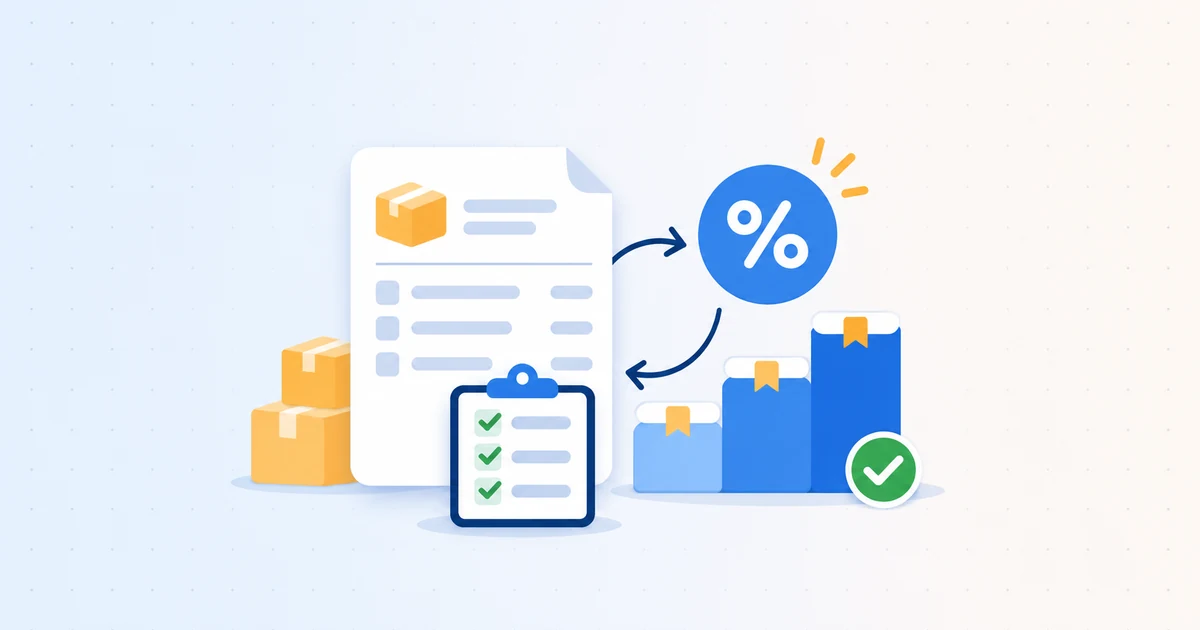
Sometimes it arrives as a letter in January, with a new price list and a paragraph about raw material costs. Sometimes as a message from the sales rep. And often with no warning at all: a unit price that changes from one invoice to the next. A supplier price increase is neither inevitable nor a formality. It can be spotted, quantified, discussed — and sometimes refused.
This article follows on from our piece on price drift: the question is no longer how to see it coming, but what to do once it is on your invoice.
This article is general guidance, not legal advice. Contract rules vary from one country to another; for a high-stakes contract, take proper advice.
Three kinds of supplier price increase
| Kind | What it looks like | Where to see it |
|---|---|---|
| Announced | New price list, letter or email with an effective date | In your inbox — then on the invoices, to check it is applied as announced |
| Silent | The unit price changes on the invoice, without a word | On the invoice lines, compared with the previous price |
| Hidden | Smaller pack at the same price, discount withdrawn, delivery charge added, product swapped for a dearer one | By bringing prices back to a price per kilo or per litre, and reading the extra lines |
The hidden increase is the hardest to see: a case that goes from six bottles to five at the same price is 20% more per litre.
Step 1: spot the increase and put a value on it
Compare like with like
Prices can only be compared unit for unit. Bring every price back to a price per kilo, per litre or per piece. Otherwise a pack-size change looks like a decrease — or like a dramatic increase that is not one.
Value it, do not just quote a percentage
A 30% increase on a spice bought twice a year weighs less than 3% on the butter bought every week. Work out the twelve-month impact: unit increase times volume bought. A hypothetical example: 0.40 more per kilo on a product bought at 50 kg a week comes to around 1,040 by value over a year.
Prioritise
Rank increases by impact in value. The top three or four justify a call this week; the rest can wait for the next annual negotiation.
Step 2: check where you stand before you call
Before picking up the phone, re-read what was agreed: contract, special terms, accepted quote, the email confirming a negotiated price.
- A fixed price for a period. If your agreement fixes a price until a given date, an increase before then is a contractual question, not just a commercial one.
- A price review or indexation clause. If your contract has one, check it is applied to the letter: reference index, date, frequency, notice period.
- A price the supplier sets alone. If your agreement lets the supplier set prices, ask it to explain how the new price was calculated.
- “Exceptional circumstances.” A supplier facing a sharp, unforeseen rise in its costs may ask to renegotiate. Ask what exactly changed, and by how much, before discussing any new price.
- The price list itself. Ask for the current price list and terms of sale in writing. In France, for example, a supplier that has general terms of sale must provide them, including its unit price list, to any business buyer who asks (Commercial Code, article L441-1, in French).
Without a fixed price in writing, the discussion will be mostly commercial. That is the next step.
How to negotiate a supplier price increase
Challenge an increase with facts, not frustration.
- Ask for the justification. Which raw material, which index, what share of the final price? If an input that makes up a third of a product’s cost rises by 15%, that alone does not justify a 15% increase on the finished product.
- Bring your history. Prices paid over twelve months, volumes, your share of spend with this supplier, the length of the relationship, how reliably you pay.
- Compare. The same product, per kilo, from another supplier or at another site in your group. A documented gap carries more weight than a threat.
- Trade, if you accept part of it. A later effective date, a capped or phased increase, a price held for a set period, a lower minimum order for free delivery, a year-end rebate tier.
How to push back on a supplier price increase — and make it stick
Pushing back starts with putting it in writing. A refusal on the phone is forgotten; a dated letter or email stays. It should state:
- the products concerned, and the price you consider applicable;
- what you rely on: agreement, quote, price confirmed in writing;
- what you expect: the price maintained, a credit note on invoices already issued at the new rate, or a meeting to discuss it.
Then you have to hold the line: check, when matching invoices, that the following ones go back to the right price. This is where many refusals get lost: the supplier agrees on the phone, and the old price never makes it back onto the invoice. If the supplier holds firm, you still have options: put the business out to tender, switch products, cut volumes or rework the recipe that uses it.
Vendor price increase letter: a template to push back
A generic template to adapt to your situation. It is not legal advice.
Subject: price increase on [product(s)] — invoice no. [number]
Dear [name],
Your invoice no. [number] dated [date] shows an increase in the price of [product], now invoiced at [new price] per [unit] instead of [previous price], an increase of [x%].
[Choose one:] This price was agreed until [date] in [our agreement / your offer / your written confirmation] dated [date], attached. / We received no prior notice of this change.
Please send us your current terms of sale and price list, together with the details that justify this increase.
In the meantime, we ask you to apply the agreed price of [agreed price] per [unit] and to issue a credit note for the difference on invoices [numbers], i.e. [difference by value].
We are happy to discuss this and suggest a call before [date].
Kind regards,
[Name, role, site]
Stop increases slipping through on the invoice
The hardest part is not challenging an increase: it is seeing it in time, then checking that the price you secured is the one invoiced. That is the job of Eqolux price and supplier alerts.
- Every price paid is compared with its history and your negotiated prices, line by line.
- Price spikes are spotted automatically, product by product, and you are alerted as soon as a product drifts, not at month end. Every alert shows its source and its impact by value.
- Price changes are ranked by extra cost in value, looking back up to 24 months, with pack-size changes neutralised.
- Your negotiated prices, recorded as fixed prices, are compared with invoiced prices, including retroactively on past documents: the price you secured can be checked invoice after invoice.
In supplier management, share of spend, products delivered, price trends and year-end rebates sit in one place, so you go into the discussion with facts. And every figure stays linked to its invoice line and the original PDF: it stands up in front of the supplier.
Key takeaways
- A supplier price increase comes in three forms: announced, silent or hidden. The last one only shows when you bring prices back to per kilo or per litre.
- Value each increase over twelve months to decide where to act first.
- Re-read your agreement before you call: fixed price, review clause, terms of sale.
- Challenge with facts — history, volumes, comparison — and ask for the justification.
- A refusal goes in writing, then gets checked on every following invoice.
Want to see which increases are costing you most? Explore Eqolux price alerts or book a demo on your own purchase history.